
When I see people search for sale maltese, they usually want one thing: a real, healthy Maltese from a source that will not disappear after you send a deposit. The problem is that this keyword attracts scams, “teacup” hype, and listings with missing paperwork. In this guide, I share the exact screening steps I use, the questions that expose bad sellers fast, and what “legitimate” really looks like in Pennsylvania and beyond.

Understanding The Search: Explain what individuals are looking for when they type this phrase into search engines and what their primary intent is.
When someone types for sale maltese, I read it as a high-intent query. They are not browsing breed history. They want availability, price reality, and a way to avoid getting burned. In my experience helping families screen listings, most people are trying to solve three fears at once: “Is this puppy real?”, “Is it healthy?”, and “Will I regret this in six months?”
Here’s the thing: the Maltese is popular, small, and easy to market with cute photos. That makes it a magnet for listing flippers, puppy mills that rebrand as “boutique,” and outright scammers who steal images.
What To Expect: Outline the different types of Maltese available including puppies, adults and purebred options.
In real listings, you will usually see one of these categories:
If you want predictability in coat and size, a purebred is usually the clearer path. If you want a potentially broader genetic mix, some crosses can fit well, but only if the source is transparent.
Realistic Availability: Guide the writer to discuss typical wait times and how to identify legitimate listings when searching for this breed.
Realistic wait times vary. I have seen families find a reputable older puppy within two weeks, and I have also seen people wait months for a very specific preference (female, pure white, small adult size, and a certain temperament).
A legitimate listing usually has:
Setting Expectations: Inform readers about the importance of researching health, temperament and authenticity before making a commitment.
I tell buyers to treat Maltese shopping like hiring someone for a long-term job. If you rush, you pay twice: once in money, then again in vet bills and stress. The Maltese can be a sturdy little dog, but it is also small enough that poor breeding and poor early care show up fast. Temperament, socialization, and early handling matter as much as a cute face.
Location Specific Search Tips: Cover how to narrow down reputable options specifically within Pennsylvania and surrounding areas.
When I search Pennsylvania listings, I narrow by process, not by ads. I start with sources that have accountability, then I work outward:
To keep your search tight, look within a drivable radius first. If a seller insists on shipping without meeting or refuses a visit, I move on.
Verifying Local Listings: Guide the writer to explain red flags to watch for with local sellers and how to confirm legitimacy.
The red flags I see repeatedly in “local” listings:
What I do instead is simple: I request a live call and ask them to do three actions on camera: call the puppy, show its belly and teeth briefly, and show the puppy walking. Scammers hate live, specific requests.
Connecting With Nearby Options: Detail the importance of visiting in person and asking the right questions before committing to a local puppy.
If the seller is within driving distance, I prefer visiting. It is not about judging someone’s house, it is about seeing the puppy’s baseline: smell, cleanliness, social confidence, and whether the puppy is comfortable being handled. I also want to meet the mother if possible.
Selling Point: Encourage readers to reach out to vetted local sources for the most up to date availability and to secure their preferred puppy before current litters are spoken for.
If you want the highest chance of a healthy match, reach out to vetted local sources and ask to be notified when the next suitable puppy is available. In practice, the best pups are often spoken for before the general public ever sees a listing.
Price Reality Check: Explain the typical price range for a healthy Maltese and why finding one under five hundred dollars is extremely rare.
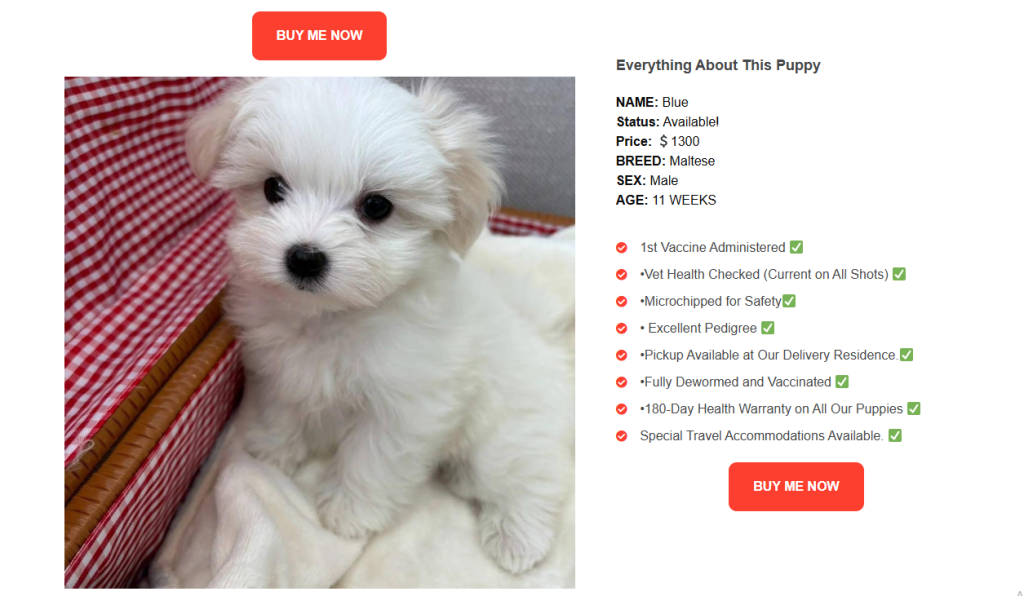
In my experience reviewing listings, a healthy Maltese puppy from a responsible source is rarely under $500. When I see that number, I assume one of three things: the puppy is not actually a Maltese, the puppy is unhealthy or poorly raised, or the listing is a scam. Ethical breeding, vaccinations, quality food, grooming exposure, and veterinary care cost real money.
Hidden Costs To Be Aware Of: Detail additional expenses such as vetting, vaccinations, grooming needs and proper care supplies.
Even if the purchase price is manageable, the first-year costs surprise many owners. The Maltese needs consistent grooming and dental attention. I budget for:
Avoiding Risky Deals: Guide the writer to cover the potential red flags tied to unusually low pricing such as poor breeding practices or health concerns.
The “cheap puppy” deal often becomes the expensive puppy. I have seen families spend far more on parasites, recurring diarrhea, and respiratory issues because the puppy was raised in poor conditions. If the seller cannot show vet documentation and a coherent feeding schedule, I do not negotiate. I walk away.
Budget Planning Tips: Provide readers with realistic savings expectations to ensure they are financially prepared for the lifetime care of their new companion.
My practical rule: if the puppy price would drain your emergency fund, pause. Set aside a buffer for the first 90 days, because that is when issues surface. If you want a small dog with predictable costs, you want predictable sourcing.
Table 1: “Too Cheap” Listing Risk Check (Decision Table)
| Listing Clue | What It Often Means | What I Do Next |
|---|---|---|
| Under $500 price | Scam, mislabel, or poor care | Require live video plus vet records |
| Seller avoids questions | Low transparency | End conversation |
| No vet paperwork | Unknown health status | Do not proceed |
| “Delivery only” | Harder verification | Only proceed with strict proof |
Understanding Size Terminology: Clarify the difference between true Maltese size standards versus terms like mini, tiny and teacup that are often misleading.
This is where I take a contrarian stance: “Mini Maltese” and “teacup Maltese” are usually marketing labels, not meaningful standards. The Maltese is already a toy breed. Breed standards describe a small dog, but “teacup” is not a recognized category in major breed standards.
If someone is selling “micro teacup,” I ask what the adult weight range is, what the parents weigh, and what the vet has documented. If the answers are vague, I treat it as sales talk.
For an authoritative reference on breed standards, you can review Maltese breed information from the American Kennel Club breed page using anchor text: Maltese breed standard.
Health Considerations: Explain the potential health risks that can be associated with extremely small sized variations of the breed.
In practice, extremely tiny puppies can be more fragile. I have seen “extra small” pups struggle with basic things: maintaining blood sugar, handling cold temperatures, and staying hydrated. Small does not automatically mean unhealthy, but chasing extreme tiny size can increase risk.
For general veterinary guidance on choosing healthy pets and working with a veterinarian, see the AVMA pet owner resources with anchor text: vet care guidance.
Identifying Ethical Breeders: Guide the writer to cover what questions to ask to ensure size claims are honest and not coming from irresponsible practices.
Here are the exact questions I ask when someone claims “mini”:
If a seller cannot answer these without defensiveness, that tells me a lot.
Setting Realistic Expectations: Help readers understand the breed standard size to avoid falling for exaggerated marketing claims.
A realistic approach is to pick a puppy for temperament and health first. If you insist on the smallest puppy in the litter, you may be selecting for fragility, not quality. I would rather take a confident, sturdy puppy that grows into a healthy adult than a tiny puppy that needs constant emergency-level vigilance.
Understanding Maltese Mixes: Explain what popular crosses like Maltichon are and how their traits can differ from a purebred Maltese.
Maltese mixes can be great, when they are represented honestly. A Maltichon, for example, can combine traits from Maltese and Bichon-type lines, but outcomes vary. In my experience, mixes are often marketed as “hypoallergenic guaranteed,” which is not how coats work.
Temperament And Grooming Differences: Detail how mixing can impact coat type, size expectations and overall personality.
I have handled Maltese mixes that were calm and easy, and others that were more energetic than buyers expected. Grooming can be easier or harder depending on coat texture. If you buy a mix, ask what grooming routine the breeder or rescue has already introduced.
Finding Responsible Sources: Guide the writer to cover how to verify the health and background of a mixed puppy before purchasing.
For mixes, transparency matters more than labels. I want:
Weighing Pros And Cons: Help readers decide if a mix aligns better with their lifestyle and expectations versus a purebred option.
If you value predictability, choose a purebred from a responsible source. If you value flexibility and are open to variation, a mix can be a great match. The key is honest sourcing.
Health Testing Musts: Cover the essential health screenings and documentation a responsible breeder should be able to provide for their Maltese.
I ask for proof that the breeder takes health seriously, not just “my dogs are healthy.” A good starting point for understanding health testing frameworks is the OFA database, where many breeders record health results. External link: Orthopedic Foundation for Animals using anchor text: OFA health tests.
Viewing The Environment: Explain why meeting the puppy’s parents and seeing the living conditions is a non-negotiable step.
When I visit, I look for confident puppies that approach people, not pups that freeze in the corner. I also want to see where the dogs sleep and play. If the environment is chaotic or filthy, that is a hard stop for me.
Red Flags To Watch For: Guide the writer to detail warning signs such as lack of transparency, no health guarantees or pressure to send money upfront.
My personal no-go list:
Getting Paperwork In Order: Inform readers on what contracts, vaccination records and registration information should be provided prior to bringing their puppy home.
Before money changes hands, I want the paperwork list in writing. If they say “I’ll send it later,” I assume it never comes.
Table 2: Breeder Paperwork Checklist (Quick Scan)
| Document | What It Proves | Non-Negotiable? |
|---|---|---|
| Vaccination record | Care timeline | Yes |
| Deworming record | Parasite prevention | Yes |
| Sales contract | Terms and responsibilities | Yes |
| Registration papers | Line documentation | Depends |
Adoption Availability: Explain how often Maltese become available through rescues and what the typical process looks like.
Adoption is real, but it can be unpredictable. In my experience, Maltese and Maltese mixes do show up in rescues, often due to owner lifestyle changes or grooming cost surprises. The process usually includes an application, home check, and a meet-and-greet.
Cost Differences: Compare the financial investment between adoption fees versus purchasing from a breeder.
Adoption fees are usually lower than breeder purchase prices, and they often include spay or neuter and initial vet work. Buying from a responsible breeder costs more upfront, but it can come with deeper background information.
Health And Background Insight: Guide the writer to cover what information is typically available with rescues versus breeders.
A breeder may offer lineage details and early-life care history. A rescue may offer real-world foster observations, which can be incredibly valuable. I have seen rescue dogs come with better temperament notes than many breeder listings.
Matching Lifestyle Needs: Help readers determine which route best suits their preferences, timeline and desired level of background knowledge on the dog.
If you need a puppy by a specific date, a breeder may be more predictable. If you are flexible and value giving a dog a second chance, rescue can be perfect.
Temperament Indicators: Cover the key personality traits of a well-socialized Maltese such as friendliness, confidence and comfort with handling.
I look for a puppy that recovers quickly from new experiences. I gently touch paws, ears, and mouth. A good sign is a puppy that wiggles, adjusts, then relaxes.
Physical Health Signs: Explain what to look for in a puppy’s coat, eyes, energy levels and overall body condition.
I check eyes for clarity, coat for cleanliness, and energy level for balance. A sleepy puppy after play is normal. A lethargic puppy all the time worries me.
Age Considerations: Guide the writer to discuss the benefits and considerations of different age ranges available.
An older puppy can be a hidden gem. You often see personality more clearly, and basic routines may already be started.
Avoiding Common Issues: Help readers spot early warning signs that could point to underlying health or socialization concerns.
If a puppy coughs repeatedly, struggles to breathe, or has constant runny stool, I pause and ask for veterinary documentation.
Verification Essentials: Explain the steps to confirm a seller is reputable including requesting documentation and video calls.
My verification sequence is:
Common Scam Warning Signs: Detail red flags such as requests for unusual payment methods, stock photos or unwillingness to meet in person.
If they ask for gift cards, crypto, or wire transfers, I stop. If photos look like professional studio shots with inconsistent backgrounds, I reverse image search them.
Researching The Source: Guide the writer to cover how to look into reviews, references and consistency of the seller’s history.
I look for a consistent footprint: same phone number, same location, same business name, and a history longer than a few weeks. A brand-new profile with perfect reviews is suspicious.
Protecting Yourself: Provide actionable steps readers should take to safeguard their investment before sending any funds.
I never send a deposit until I have:
Table 3: Legit Listing Scorecard (Fast Decision Tool)
| Check | Pass Looks Like | Fail Looks Like |
|---|---|---|
| Live video | Real-time puppy interaction | Refuses or sends clips |
| Vet records | Named clinic, dated records | “Trust me” |
| Contract | Written terms | None |
| Payment | Protected method | Wire, crypto, gift cards |
Breed Standard Colors: Explain the traditional white coat of the Maltese and what is considered acceptable within the breed standard.
Most buyers expect a white Maltese, and that is the classic look. I tell people to focus less on “perfect white” and more on coat health and skin comfort.
Rare Color Claims: Cover the misconceptions around black or other rare colorings and why they are often tied to misrepresentation or mixes.
When I see “rare black Maltese,” I assume misrepresentation until proven otherwise. It may be a mix, or a seller using color language to justify a higher price. I am not against mixes, I am against dishonest labeling.
Grooming And Maintenance: Guide the writer to discuss how coat color can sometimes impact visibility of staining and overall upkeep needs.
Tear staining is common in light-coated dogs. It is not always a deal-breaker, but it does require grooming habits. I ask what the puppy is eating, what water source they use, and how they clean the face.
Avoiding Misinformation: Help readers understand how to verify color authenticity before committing to a specific listing.
If color is critical to you, ask to see the parents, ask for clear photos in natural light, and get the labeling in writing. If it is a mix, it should be stated plainly.
Health Records: Detail the vaccination history, deworming schedule and recent vet checks that should come with the puppy.
At minimum, I want a dated vaccination and deworming record. If the seller cannot produce it, you are guessing. That is not acceptable when you are taking responsibility for a living animal.
Breeding Documentation: Explain when registration papers like AKC are applicable and what they actually prove.
Registration papers can document lineage, but they are not a health certificate. I have seen registered dogs with poor health practices behind them. Treat registration as one piece of the puzzle.
Health Guarantees: Guide the writer to cover what a legitimate health guarantee should include and the typical timeframes offered.
A real health guarantee is written, time-bound, and explains the remedy. It should not be vague. If the guarantee is only verbal, it is not a guarantee.
Sales Agreement Importance: Inform readers of key terms that should be outlined in writing to protect both parties involved in the purchase.
I look for terms on deposits, returns, spay or neuter expectations if any, what happens if a veterinarian finds an issue, and whether ongoing support is offered.

Must Have Supplies: Cover the essential items needed prior to arrival including grooming tools, safe bedding and appropriate nutrition.
My must-have list: a safe crate, a playpen, a small harness, grooming brush and comb, puppy-safe shampoo, and a quality food plan. I also keep a small digital scale for tracking early weight changes.
Puppy Proofing Your Space: Explain how to create a safe environment to protect this small breed from common household hazards.
Small dogs get injured in ways large dogs do not. I block off stairs, remove dangling cords, and teach kids to sit on the floor when holding the puppy.
Scheduling First Vet Visit: Guide the writer to stress the importance of a wellness check shortly after bringing them home.
I schedule a vet visit within a few days. It protects the puppy and it protects you financially if something was misrepresented.
Selling Point: Encourage readers to secure their new companion with confidence by utilizing trusted preparation resources and locking in availability with a reputable source before the perfect match is gone.
If you do the prep early, you avoid panic buying. When the right puppy appears, you can commit with confidence, because your home, vet plan, and paperwork checklist are ready.
Walking through the step-by-step process from initial inquiry to bringing your puppy home.
This is the step-by-step process I follow, and it has saved buyers from the most common traps:
Understanding contracts, guarantees, and ongoing support from breeders.
A reputable source expects questions. They do not rush you. They also provide support after the sale. I value breeders who give feeding instructions, grooming guidance, and a realistic transition plan.
Preparing your home and family for the arrival of a new Maltese puppy with expert guidance.
Use case 1: I worked with a family that bought a Maltese for a senior parent. We chose an older puppy with a calmer temperament, and we set up non-slip rugs, a pen area, and scheduled grooming introductions early. The outcome was smoother bonding and fewer stress behaviors.
Evaluating the reputation and specialization of Pennsylvania-based breeders.
Pennsylvania has a mix of sources, from excellent small hobby breeders to high-volume operations. My advice is not “trust a state,” it is “trust a process.” I have seen great breeders in Pennsylvania and weak breeders outside it, and the reverse.
Comparing regional breeding practices and puppy availability across different states.
Some states have more concentrated hobby-breeder networks, while others have more large-scale commercial breeding. The only reliable way to compare is to ask about health testing, early socialization routines, and whether you can verify the puppy’s environment.
Discussing transportation and logistics when purchasing from out-of-state breeders.
If you buy out of state, I prefer in-person pickup. If shipping is involved, get the full plan in writing, confirm temperature considerations, and confirm who is responsible if delays happen.
Use case 2: A buyer insisted on a “teacup” from out of state. We switched them to a standard healthy puppy after a vet explained the fragility risks. The buyer spent less time worrying and more time enjoying the puppy, which was the real win.
I start with rescues, breed clubs, and reputable breeders who will prove identity, show the puppy live, and provide paperwork before deposit. If you use marketplaces, treat them as lead generation only and run a strict verification process before paying anything.
If you want predictability and detailed early history, purchasing from a responsible breeder can be a better fit. If you want to give a dog a second chance and you can be flexible on timing, adoption can be ideal. I decide based on timeline, comfort with unknowns, and the quality of available sources.